Free consultation

ABOUT THE CLIENT

Due to a non-disclosure agreement (NDA), the client’s name remains confidential. It is one of the largest entities in Poland specializing in the construction of road and railway infrastructure. The company manages a fleet of approximately 200 diverse vehicles (trucks, construction equipment) and executes highly complex public and commercial projects.
ABOUT THE PROJECT

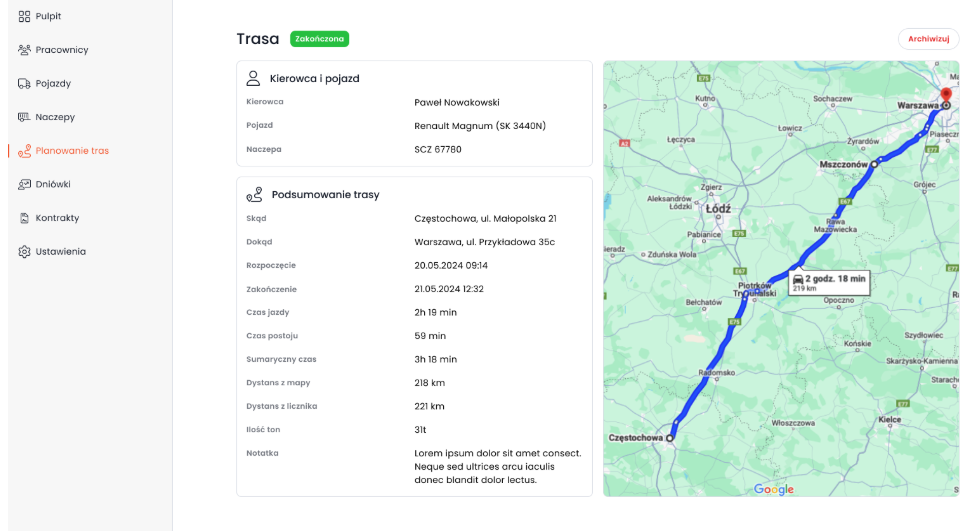
The Waybill Management System is a comprehensive analytical and operational environment that fully digitizes the management of drivers’ work, linking telematics with advanced settlement rules.
Implemented for one of the largest infrastructure entities in Poland operating a fleet of over 200 vehicles, it allows precise control over fuel consumption, working time, and the profitability of complex contracts. Thanks to the intelligent centralization of dispersed data and the replacement of paper waybills and Excel spreadsheets, the platform not only drastically speeds up administration but also changes the way the company makes financial and logistical decisions.
INITIAL REQUIREMENTS / CONSULTING
Evolution of expectations
Initially, the client assumed that creating only a digital equivalent of a paper waybill would be a sufficient and relatively simple solution, which was merely supposed to simplify record-keeping for drivers and operators.
Strategic pre-implementation analysis
GoMobilityTech’s expertise quickly showed that this approach does not utilize the potential of digitalization. We pointed out that integrating the entire process systematically—starting from the beginning of a workday in the field, through collecting data from machines, to the automatic generation of ready-made reports for the finance and contracts department—would bring much greater business value.
CHALLENGE / ANALYSIS

Digitalization of long-standing, diverse processes
The biggest operational challenge was transforming deeply rooted processes into a single, cohesive organism. Over the years, the organization had developed highly flexible methods for recording routes and fuel consumption, tailored to the individual requirements of site managers. The change required reconstructing these habits in a way that standardized the company’s work while gaining the trust and acceptance of conservative field users.
Extreme reliance on Excel spreadsheets
Administration relied entirely on spreadsheets, which allowed for almost unlimited freedom in settlements, formulas, and exceptions. Although seemingly convenient, from the perspective of managing the entire organization, this meant a lack of full cost control, a blurring of business logic, and a huge susceptibility to delays and human errors.

Dispersed telemetric and fuel data
The third significant problem was data fragmentation. Vehicle GPS monitoring systems and fuel probes operated independently and were in no way linked to information about completed routes and employee shifts. Manually assigning refuelings and mileage led to losses and severely limited the reliable verification of equipment efficiency in the field.
PROJECT GOALS

Comprehensive digitalization of records
Replacing paper waybills and manually filled Excel spreadsheets with a single, cohesive system tool, easily accessible to every field and office employee via an app and a web browser.

Automation and centralization of data flow
Seamlessly linking raw data from telematics, vehicle odometers, and fuel probes directly to virtual waybills and assigned contracts, to completely eliminate manual entry and correction of values.

Shortening settlement times by orders of magnitude
Optimizing the monthly process of compiling logistical data—transitioning from labor-intensive calculations taking anywhere from a few to a dozen days, to the automatic generation of ready-made fleet reports within a few hours.

Standardization of decision-making processes (Rules Engine)
Extracting logic, rates, and exceptions from employees’ heads and Excel files into a central operating system, ensuring the uniformity and auditability of all of the company’s financial and logistical decisions.

Real-time cost transparency
Providing managers, contract managers, and finance departments with instant access to reliable indicators on machine fuel consumption, route mileage, and profitability, enabling them to react to anomalies while work is ongoing.

Scalable architecture and openness to systems (API)
Designing an advanced structure that will seamlessly integrate with the company’s existing external TMS and ERP solutions, as well as advanced telematics platforms for construction equipment.
Solution description
A comprehensive operating system was built to act as a central environment for logistics, telematics, and settlements. The system was developed in a modular architecture, which made it possible to standardize data flowing from various sources (drivers, machines, probes) and automatically map them to contract settlements and construction projects in real time.

PROJECT DETAILS / IMPLEMENTATION
The system’s modular architecture, divided into layers (Data Hub, Driver App, Contracts & Settlements), enables the seamless processing of raw logistics data into a standardized settlement model.
Information from various telemetric devices flows into a central database, where it is continuously mapped, validated, and assigned to specific construction projects, effectively eliminating discrepancies from individual fleets.
The platform was equipped with a dedicated Configuration Engine, allowing administration to redefine rates, thresholds, and operational exceptions without any programming intervention.
The result is a powerful and scalable environment integrating the client’s TMS and ERP processes, capable of flawlessly generating complex financial reports in just a few hours.

Mobile layer (Driver App)
A web application for drivers and operators enabling the start of a workday, registration of routes and stops, as well as adding photos of documents during work directly from a phone.

Integration layer (Data Hub)
An engine responsible for collecting and synchronizing diverse telematics data, eliminating errors resulting from differences in fleet device formats.

Business layer (Contracts & Settlements)
A module that automatically processes field data and assigns registered routes straight to specific contracts, applying the appropriate rules or rates.

Analytical layer (Dashboards)
Insight panels for the board and finance departments allowing them to monitor fleet efficiency, fuel consumption, and summaries, as well as sending alerts in case of cost deviations.

Rules engine (Configuration Engine)
An extensive administrative panel that allows managers to independently reconfigure rules, thresholds, and rates without the need for any programming intervention.
RESULTS AND BUSINESS
IMPACT
The digitalization of waybill handling became a solid foundation for the client to manage costs, productivity, and the predictability of their entire construction fleet. The implementation drastically changed the nature of settlements from a tedious administrative task into a rapid source of strategic data.
80% reduction in settlement time: Monthly reports, previously taking 2-3 days to create in Excel, currently take the staff a few hours.
Over 70% reduction in errors: Completely eliminating the need for manual data transcription translated into error-free, standardized reports for the board.
Full fuel consumption transparency: The system automatically assigns refuelings to specific shifts, exposing any anomalies, discrepancies, and potential resource losses.
Increased fleet efficiency: Accurate and ongoing analysis of stops and routes currently allows for significantly better planning of future tasks for machines in the field.
Integrated reporting for the board: Managers gained a central KPI panel providing real-time, cohesive insight into the profitability analysis of equipment operations from the perspective of the entire month and individual days.
CLIENT TESTIMONIAL

“This implementation changed the way we think about data. Previously, we treated settlements as an administrative chore—today they are a source of knowledge about contract profitability and equipment efficiency. The GoMobilityTech team perfectly understood our specific needs and designed a solution that combines ease of use for the driver with analytical precision for the board.”
Logistics and Equipment Manager
Trusted by