 Free consultation

How do we solve the problem?
If managing the return of keys, documents, or other assets relies on physical presence…
Four scenarios that generate real losses:
in time, finances, and reputation.

Issuance and return depend on human presence
Someone must be on-site to issue a key. Someone must check if it was returned. Outside working hours — no one issues, no one checks. Result: downtime, manual workarounds, the process stops when the reception desk closes.
No one has full visibility of who holds which asset
A notebook, Excel, a corkboard, a messenger group — each of these “solutions” works only until someone forgets to log an entry. Result: booking conflicts, lack of accountability, poor operational data quality.

The process stops outside working hours
The service center cannot accept a vehicle at night. A driver cannot pick up keys before 8:00 AM. The customer waits because the office is closed. Result: downtime, customer dissatisfaction, lost orders.
The device operates in isolation — without process logic or data
The smart key cabinet is there, but it knows nothing about your organization. No roles, no rules, no integration with systems. Issuance data flows nowhere. Result: information silos, manual workarounds, lack of context for operational decisions.

These problems do not disappear on their own — they grow with every new user, vehicle, and location.
The longer manual management persists, the more time and money it costs to maintain the illusion of control.
Qualification
Who this solution is for — and who it isn’t for
Not every organization needs a dedicated system. We say this directly,
because your time is too valuable for a solution that doesn’t fit.

It makes sense if:
- You manage a fleet, facilities, or equipment shared among multiple users
- Issuing and returning assets is a repeatable process with defined rules
- You need accountability — knowing who, when, and for how long
- You have or plan to implement operational systems (ERP, fleet management, AD) with which you want to connect access control
- Your scale is growing, and manual methods no longer work

It is not for you if:
- You have 3 keys accessed by 2 people — a padlock cabinet is enough
- You are looking for an off-the-shelf device to buy online — this is not a hardware store
- You don’t have a repeatable process — there is nothing for a dedicated system to map
- You need a solution “for tomorrow” — deploying a dedicated system takes weeks, not days
Mechanism
How it works: hardware + software designed for your process
Every deployment consists of two layers — hardware and software. Together they form a system that operates according to your rules, not the limitations of the device manufacturer.

01 Authorization and roles
Who has access to what, when, and under what conditions. The permission model maps your organizational structure — shifts, positions, locations.
02 Real-time event log
Every issuance and return is recorded, assigned to a specific person, and available instantly. A full audit trail is generated automatically.

03 Rules and automation
Reservations, time limits, escalations, notifications. The system responds to events — it doesn’t wait for a manager to notice a problem.

04 Integration with your systems
API connection with operational systems — ERP, fleet systems, Active Directory. Access data flows to where you manage operations. Infrastructure: cloud (Microsoft partner), on-premise, or hybrid — the model is derived from a TCO.
Two delivery models

Integration of off-the-shelf hardware
A smart key cabinet or smartbox is selected — but the process layer is missing. We build the software that connects the device with your processes and systems.


Dedicated hardware design
No standard smart key cabinet fits? We design the device from scratch — electric locks, screens, controllers — along with dedicated software.
Effects
What changes after deployment
We don’t promise percentages we can’t prove. We show you what problems disappear.

01
No more blind spots
You know in real-time who has what asset, since when, and when they should return it. No phone calls, no searching through notebooks.
02
Accountability without extra work
A full audit trail generates automatically with every issuance and return. No manual entries, no gaps.
03
Fewer downtimes and conflicts
Automated rules eliminate booking collisions, catch overdue returns, and escalate before the problem lands on a manager’s desk.
04
Self-service instead of manual service
Users pick up and return assets on their own — via PIN, RFID, QR code, or mobile app. No queues, no contact with reception, 24/7.
Effects
Four production deployments tailored to your specific process
Every deployment means a different process, a different industry, different requirements. One thing
is common — a system designed for the client’s specific problem.

Ecologic
INTEGRATION
Corporate car sharing · Corporate fleet
A dedicated solution for car fleets with a limited number of vehicles. Users book vehicles, and collect keys and documents independently. Everyone sees vehicle availability for a given period in real-time.
Assured Europe
INTEGRATION
Parking operations · Airports
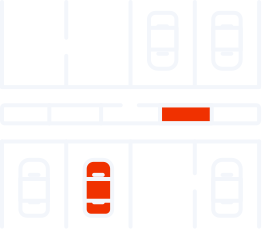
Smart key cabinets at airports — a traveler leaves the vehicle at the terminal, drops the key in the cabinet. The car is moved to a large parking lot and brought back upon return. The entire process runs via a mobile app, with no contact with staff.
Lemir
INTEGRATION
Car dealership and service center
Customers drop off their vehicles at any time of day or night, leaving the keys in the smart key cabinet. The service advisor contacts the owner, performs the service, and after payment, makes the vehicle available for pickup — again via the smart key cabinet.
Variants
Three deployment variants — tailored to process complexity and budget
Not every deployment has to be enterprise. We present three paths — the choice of variant is the result of a discovery workshop, not a decision made before the conversation.

MVP
Quick start, basic control
50 – 150k PLN
net
2–3 months
- Integration with client’s system (REST/SOAP/GraphQL)
- Device app with a basic UI
- Process logic: issuance, return, authorization, timeouts
- Basic infrastructure and CI/CD
- Simplified offline support (polling)
- Minimal monitoring
For organizations that want to quickly validate the solution in a single location before scaling.
Standard
Full process logic, stable synchronization
150 – 300k PLN
net
4–6 months
- Full backend integration with webhook support
- Advanced device app
- Full process logic with exception handling
- Offline + retry + stable synchronization
- UX designed for real working conditions
- Basic monitoring and alerts
For organizations with a stabilized process that need a reliable production system.
Enterprise
Event-driven architecture, full resilience
300 – 600k PLN
net
6–10 months
- Event-driven architecture
- Full resilience to errors and edge cases
- Multi-device, multi-location
- Advanced security and compliance
- Observability: logs, alerts, remote diagnostics
- Device provisioning and management
For organizations with multiple locations, compliance requirements, and the need for full observability.
Risks
Concerns you might have — and how we address them
We don’t pretend risks don’t exist. We organize them and show you how we work with them.


„This probably costs much more than just the smart key cabinet.”
Yes — because the smart key cabinet alone doesn’t solve the process problem that brought you here. Based on identifying your problem and mapping the process, we can quickly determine the target implementation cost — allowing you to assess the ROI before making any commitment. We prepare an initial estimate within a maximum of 5 days from contact.

„How long does the deployment take?”
From 2–3 months for the basic variant up to 6–10 months for the enterprise solution with full event-driven architecture and offline support. Time depends on process complexity, the number of integrations, and the device model. We establish a framework schedule after discovery.

„What if the scope creeps?”
That’s why discovery is a mandatory stage — we don’t skip it. 1–2 days of analyzing the process, client API, and device. This is where we identify unknowns before they become costly surprises. After discovery, we prepare a free implementation offer in up to 5 business days — with a clear scope, variant, and schedule. We work in defined stages with validation on your side.

„Will people use this?”
The system maps your existing process — it doesn’t impose a new one. We design the device UX for real conditions: gloves, night shifts, users with varying technical skills. We minimize the number of steps. If your people currently pick up keys from a hook at the reception desk — the system must be just as simple, but with a log and rules in the background.
Next step
What happens after clicking “Book a call”
No obligation. No pressure. Just specifics.
You will book a 30-minute call. You will tell us about your process — how asset management looks today, what isn’t working, and the scale involved. We will verify the implementation complexity, identify barriers, and present an initial offer based on that. If a standard off-the-shelf smart key cabinet is enough — we will tell you directly. Initial estimate in a maximum of 5 days from contact.
FAQ
From the first conversation to launch — what the collaboration looks like

How much does it cost?
MVP variant (basic control, simplified offline): 50–150k PLN net, 2–3 months. Standard variant (full process logic, offline, stable synchronization): 150–300k PLN net, 4–6 months. Enterprise variant (event-driven architecture, multi-device, full resilience): 300–600k PLN net, 6–10 months. Ranges based on representative deployments. We prepare an initial estimate based on your specific use case in a maximum of 5 days from contact.
Can I use a smart key cabinet I already have?
Yes — the integration model for an off-the-shelf device is one of our two standard approaches. We build a software layer that connects your existing device with your processes and operational systems. The prerequisite: the device must expose an API or SDK to control the compartments.
What APIs do you provide?
REST API. Architectural details, data formats, and the integration model are discussed during a technical call — you can connect directly with our development team right away.
What if the device loses internet connection?
In the Standard and Enterprise variants, the system supports an offline mode — featuring a local event queue, retry mechanisms, and synchronization upon connection restoration. In the MVP variant, offline support is simplified. We match the model to the realities of your environment — if the device is located in a basement garage without a stable connection, we plan for it from the start.
Who maintains the system after deployment?
We offer system maintenance as a separate service scope. It includes monitoring, remote device diagnostics, technical support, and updates. The scope, SLA, and billing model are determined individually during the discovery stage — depending on the number of devices, locations, and your operational requirements.
Does the system run in the cloud or on-premise?
We work in the architecture chosen by the client — cloud, on-premise, or hybrid. We are a Microsoft partner for cloud solutions, but we are equally capable of deploying in on-premise environments. The target model is derived from a TCO simulation that we conduct during the discovery workshop — ensuring the infrastructure decision is based on data, not just preferences.
Do you do deployments in multiple locations?
Yes. The system architecture accounts for multi-device and multi-location scenarios. We plan the scale during the discovery stage — not every deployment has to start in all locations at once. We often recommend a pilot in a single location and expanding after validation.
Let’s talk about your process
30 minutes of conversation. Initial estimate in a maximum of 5 days. No obligation. If a standard off-the-shelf smart key cabinet is enough — we will tell you directly.