 Free consultation



Building a telematics platform is
harder than it looks
Most development teams can set up a backend and display a point on a map. The trouble starts when the platform needs to operate at the scale of thousands of vehicles — with real data, in real time, compliant with the requirements of the TSL industry.

Shipment status
where it is, when it will arrive, why it is delayed

Delivery pre-notification and time window change
confirmation, change, cancellation

Order detail confirmation with the driver
address, time, instructions

First-contact complaint registration
data collection, ticket number assignment

Document and invoice enquiries
confirmation, sending, status
None of these calls require a decision. None require specialist expertise. Each one requires a person who could be spending that time on something no machine can replace.
What does it cost?
At one hundred repetitive calls per day with an average call length of three minutes, that is five working hours per day spent on repetitive operations. At a 60% automation rate — which operational-grade voicebots achieve in their first months of production:
3 h / day
returned to the team’s disposal — every day, including weekends and nights
Working hours/month on repetitive patterns
~90 h
Recoverable at 60% automation
~54 h
Service availability
24/7
Every month without automation is another several dozen working hours spent on calls that a system could handle. That is also true of every peak season, when your team is overloaded and customers are waiting.
The cost of inaction is not a one-off cost. It is a monthly cost that grows alongside your business volume.
This is for you if
- You run a transport, freight, courier, or delivery company, or manage orders, and handle at least several dozen phone calls per day in repetitive processes
- You have operational systems (TMS, ERP, CRM, WMS, or a proprietary database) with real-time data access or the ability to integrate via API
- Your team is losing time on calls that are repetitive and could be handled without human involvement
- You experience seasonal or persistent call peaks that you cannot or do not want to cover by hiring additional staff
- You are looking for a partner to build a system, not sell you an off-the-shelf tool
This solution is not right for you if
- Your operational systems have no integration capability — a voicebot without data access is just an IVR automat
- Most of your phone calls involve negotiation, pricing decisions, or managing key client relationships
- The volume of repetitive calls is too low to justify the project
- You expect a ready-made product to go live within a week, with no design or integration phase
From an answered call to a closed case — without human involvement
A voicebot handling real processes in the TSL industry is not a product you can buy and simply switch on.
It is a system designed, built, and trained on your data, your processes, and your business rules.
We build it in five steps:
Tool and architecture selection
Not every voice solution is suitable for integration with TMS- or ERP-class systems. We assess which architecture fits your technology stack: integration capabilities, handling of the Polish language in operational environments (accents, industry terminology, background noise), ability to build custom conversational flows and an escalation model. We evaluate the integration model (REST API, webhook, middleware), data security requirements, responsibility for maintaining connections, what is logged, what is monitored, and who receives an alert when something happens.
Knowledge base construction
The voicebot must know what it can do, what it cannot do, and how to respond to every type of call. We inventory your processes, analyse real conversation scenarios, define business rules, escalation thresholds, and exceptions. The better the knowledge base is defined, the higher the automation rate from day one of production.
System integrations
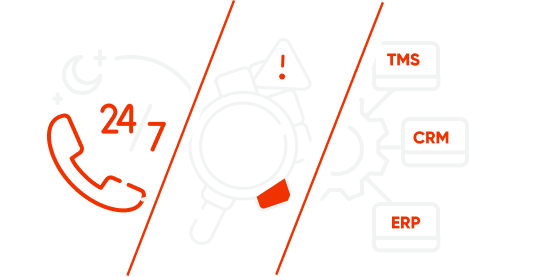
This is where the real operational value lies. The voicebot must have real-time access to data and the ability to execute actions: TMS — reading statuses, recording delivery window changes, updating schedules. ERP — order verification, document access. CRM — caller identification, contact history. Driver and route database — vehicle identification, orders, callback contact. At this stage we assess API availability and quality, data consistency, and the security model.
Training and calibration
The system learns from real cases. The first weeks of production are not just about handling traffic — they are about collecting data on what the agent handled correctly, what it escalated, and what it misunderstood. The model is then corrected and expanded on that basis.

Monitoring and continuous improvement
A live voicebot requires constant oversight: automation rates, escalation ratio, error classification, call analysis. This is the foundation for iteratively expanding the scope of automation. The goal is not the launch point — it is a growing share of operations handled without human involvement.
We work with companies building their own telematics product
Not with fleet managers looking for an off-the-shelf tool.
With technology companies that want their own product — but need a partner with deep TSL domain knowledge.

Order detail confirmation with the driver
The system detects a new order or a schedule change. The voicebot calls the driver, reads out the details, collects a confirmation, and records the result in the TMS. The dispatcher sees the status without making a single phone call.

Delivery pre-notification to the recipient
A few hours before a scheduled delivery, the voicebot calls the recipient, confirms readiness to receive the shipment, collects any constraints, and updates the schedule. The driver arrives at places where someone is expecting them.

Clarifying details
with the freight forwarder
A document is missing, the loading time has changed, or there is a question about the cargo. Instead of waiting for the dispatcher to find a free moment — the system calls, collects the information, and passes it to the right place in the system.

Proactive delay notifications
Instead of reacting to customer queries about late shipments — the voicebot proactively informs recipients of a status change and suggests available options. Before the customer calls to complain, they have already received an answer.

Many other scenarios
We can define virtually any other scenario aligned with your processes. Example: an agent monitors a freight exchange according to your criteria — route, tonnage, minimum rate. When it finds a matching offer, it checks availability in the TMS and — instead of waiting for the freight forwarder to notice — the voicebot calls the counterparty directly, confirms the details, and returns the result to the system. A human steps in only when the matter requires a decision outside the defined rules. A brief consultation is enough to make an initial feasibility assessment.
Startup with a fleet product vision
There is no operational peak at which the system becomes overloaded.
No queue of waiting calls growing after three in the afternoon. No day when you have to choose which requests to handle first.
For companies with seasonal peaks, this property has a direct financial impact — the system handles more, without hiring, without onboarding, without downtime.
DISPATCHER

VOICEBOT
What you gain the day after launch

50–70%
of calls automated
Operational time
TSL companies deploying voicebots integrated with operational systems achieve automation of between 50 and 70% of calls within the covered process scope. At one hundred calls per day with an average call length of three minutes, that is between two and a half and three and a half working hours returned to the team’s disposal every day.
24/7
without interruptions or additional cost
Service availability
The system operates around the clock, seven days a week, without interruptions and without any additional cost for nights and weekends. A customer who calls at ten in the evening to ask about their shipment status receives an immediate answer.
×500
pre-notifications in a matter of minutes
Outbound call scale
A pre-notification confirmation campaign to five hundred recipients — which would take a person many hours — takes the system just a few minutes of parallel calls. No missed contacts, with a full log of results and the ability to replay actions.
0
manual entries after a call
Data quality in systems
Every call handled by the voicebot ends with an automatic entry in the system. No manual transcription, no omissions, no delay between a call and the update of operational data.
100%
of attention on matters that require a decision
Team relief from work that requires no expertise
Dispatchers and service agents stop being operators collecting data. They focus on cases that genuinely require their knowledge, relationships, and decision-making.

without a proportional increase in labour costs
Scaling operations
Seasonal peaks, volume growth, delivery campaigns — the system handles more without recruiting, onboarding, or downtime. Most companies do not reduce headcount after deployment — they scale operations without a proportional increase in costs.
Why a standard IVR, an outsourced call centre, and self-configuring an off-the-shelf tool do not solve this problem
Each of these alternatives has its specific use case. None of them does
what an operational-grade voicebot integrated with your systems does.

Standard IVR (touch-tone menu or basic voice automation)
It redirects. It informs according to a script. It has no access to your TMS, cannot change a delivery window, and cannot log a complaint in the system. The customer still ends up with a human, only more frustrated.

Outsourced call centre
It scales human resources, but does not eliminate the cost per call. Every connection still costs. External agents do not know your systems and processes as well as your own team. Queues still form during peaks.

Off-the-shelf SaaS voicebot builder
Works well for simple FAQs and redirections. The moment you need integration with a TMS, ERP, or any other system, you hit the architectural limitations that are built into the off-the-shelf tool. You can configure a flow, but you cannot build a properly functioning operational integration.
What distinguishes a project-based approach from a product-based one

We build a system tailored to your processes, your systems, and your business rules. You are not configuring an off-the-shelf product within the available options — you get a solution that works exactly the way you require.
Read this before you say “it won’t work for us”

“Our TMS has no API.”
We assess this during the consultation. If the absence of an API blocks integration, intermediate solutions are possible — middleware, database integration, or file-based integration. We evaluate scope and limitations on a case-by-case basis; we do not assume in advance what is or is not feasible.
“The voicebot will perform an incorrect action in our production system.”
Every action the voicebot takes in your systems is designed with verification thresholds. Actions with high operational risk require confirmation or are escalated to a human. The system does not execute irreversible actions without a defined correction path.
“Our customers won’t want to talk to a bot.”
Customers don’t want to wait in a queue and repeat their story at every escalation. A voicebot that resolves a matter in thirty seconds is a better experience than a human who can’t be reached. Frustration arises when the bot fails to resolve the issue, which is why we design escalation with full context — not a dead end.
“Automated voices sound artificial and create a poor experience.”
Current technology makes it possible to create bots that are difficult to distinguish from a human in conversation. The tone is natural — the bot can laugh, take a breath, vary its vocal tone, and can even speak in your voice or the voice of one of your employees.
“After deployment we’ll be left alone with the system.”
Monitoring, calibration, and maintenance are part of the project. The maintenance terms are agreed before the contract is signed — not after go-live. The model grows alongside the data and the scope of processes.
“We don’t know how much it will cost.”
The consultation concludes with a preliminary estimate and a budget range, so you know the ballpark before committing to anything. The discovery workshop ends with a precise production quote. At every stage you know where you stand before making a decision about the next step.
From conversation to a working system
We start the collaboration by understanding the product you want to build. On that basis we propose an architecture, choose a stack, and plan the roadmap. We build iteratively — with regular deliveries of working software.

Consultation and budget estimate
Free of charge
We discuss your environment, processes, and systems. We present an architecture recommendation and indicative budget range. Deliberately approximate at this stage — a precise assessment comes after the workshop.

Discovery workshop
Paid
We map processes, define logic and business rules, design the architecture, and record acceptance criteria. Concludes with a full system specification and a precise production quote. The decision to continue is yours.

Production and testing
We build the system according to the workshop specification. We test against agreed criteria, including exceptions and edge cases.

Production deployment
We launch the system and calibrate the model on live traffic. The first automation metrics appear here.

Maintenance
We monitor, optimise, and expand the scope. The model grows with the data. Maintenance terms are agreed before go-live.
What happens after you write to us
1
We reply and schedule a call
Based on a 30-minute call we verify the complexity of the implementation, identify technical and process barriers, and present a preliminary offer — with no commitment on your part.
2
Technical call, 45–60 minutes
We ask about your systems, processes, and volume. A technical person or IT representative from your side is welcome to join.
3
Proposed approach and budget range
A concrete architecture recommendation and indicative budget range — before you sign anything.
Decision point
If the scope and budget make sense — we move to the discovery workshop. If not — you leave the conversation significantly better informed, with no commitments whatsoever.
Questions that typically come up
before a decision

Can the voicebot handle Polish in an operational environment?
Yes, but it requires selecting the right ASR engine and training on data from your environment. That is one of the reasons we start with an assessment — not with a launch.
How long does implementation take from the first call to a working system?
The production phase for the first process typically takes six to twelve weeks from the end of the discovery workshop. The timeline depends primarily on the state of integration with your systems and the quality of the data.
What if my systems have no API?
We assess this during the consultation. If the absence of an API blocks direct integration, intermediate solutions are possible — middleware, file-based integration, or database integration. We evaluate scope and limitations on a case-by-case basis.
Will the voicebot replace my employees?
It does not replace — it relieves. It takes over calls that did not require human expertise. Most companies do not reduce headcount after deployment — they scale operations without a proportional increase in labour costs.
Who is responsible for maintaining the system after deployment?
Two options are available: maintenance on our side with a defined SLA, or handing responsibility to your technical team with full documentation and training. We agree on this before go-live.
What if the voicebot does not achieve the target automation rate?
The automation rate depends on data quality, the scope of integrations, and the definition of business rules. That is why we do not give a figure before the readiness assessment — after the workshop we present a realistic range along with the conditions that must be met to achieve it.
Can I start with one process and expand the scope later?
Yes — and it is the recommended approach. Launching on a single process allows you to validate integrations, calibrate the model, and assess the real automation rate before deciding to expand.
What about the security of operational data?
The integration model, the scope of data transmitted via API, and the storage and logging policy are all defined during the architecture design phase — as part of the discovery workshop. Security is part of the specification, not something to be agreed after deployment.
Is a voicebot the only thing that can be automated in TSL processes?
No. A voicebot automates the voice channel. The same agent logic can be applied to other repetitive operational processes — for example, monitoring a freight exchange and automatically processing orders integrated with the TMS. If you are interested in a broader scope of automation, it is worth discussing this at the consultation stage.
One conversation is enough to know whether this solution is right for you.
The next step is not a purchasing decision. It is a free technical conversation, after which you will know whether and how a voicebot can work in your specific environment.